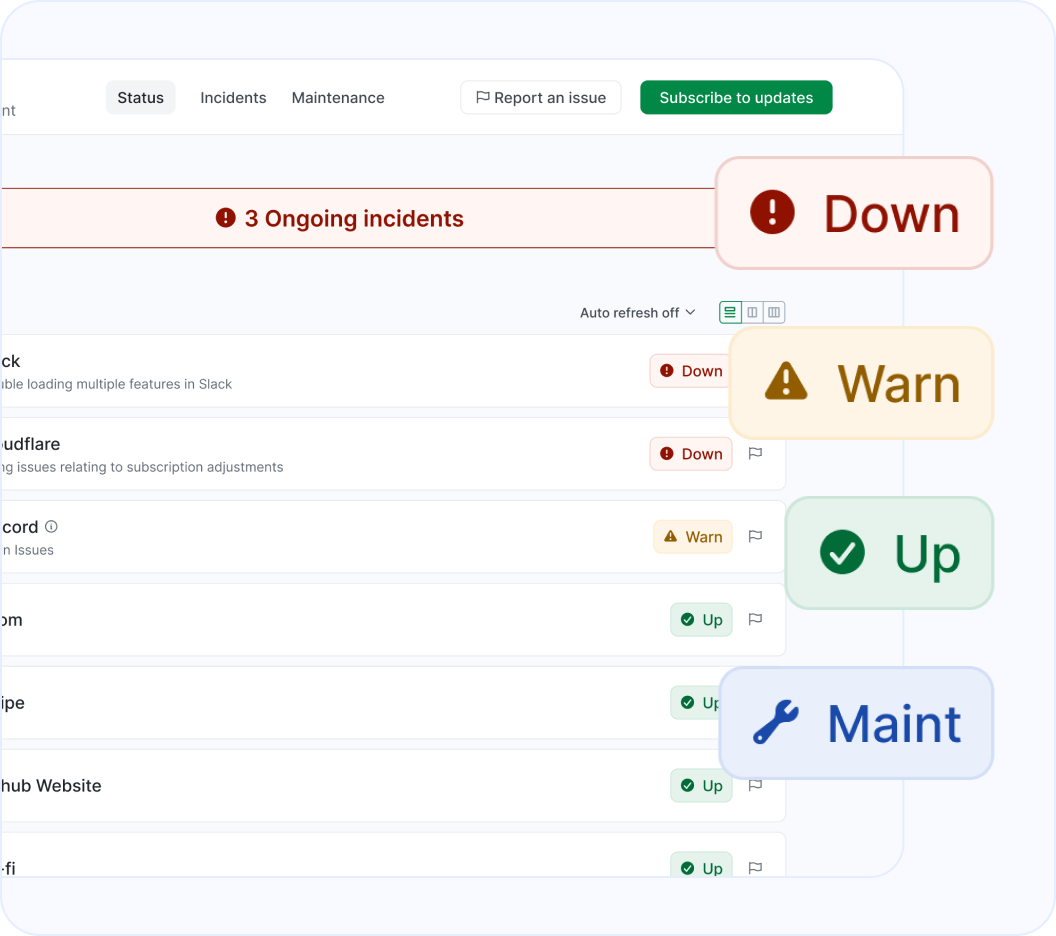
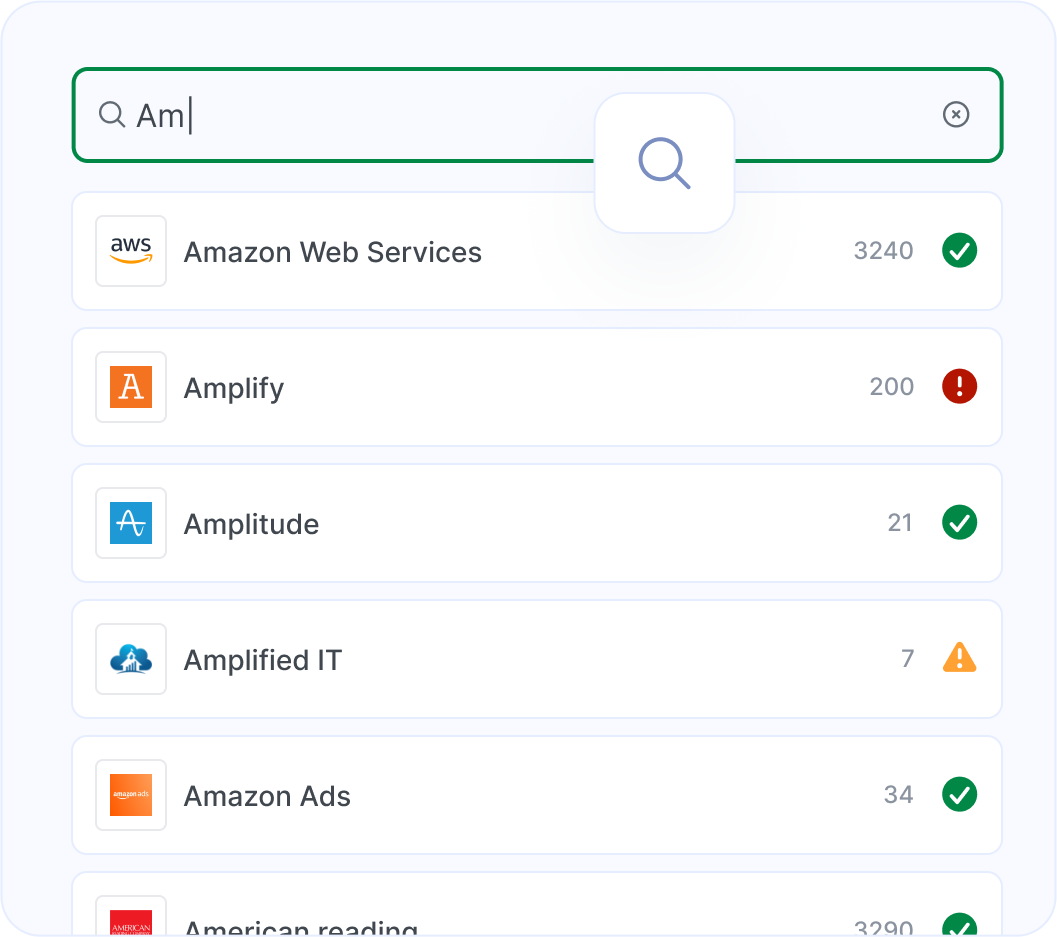
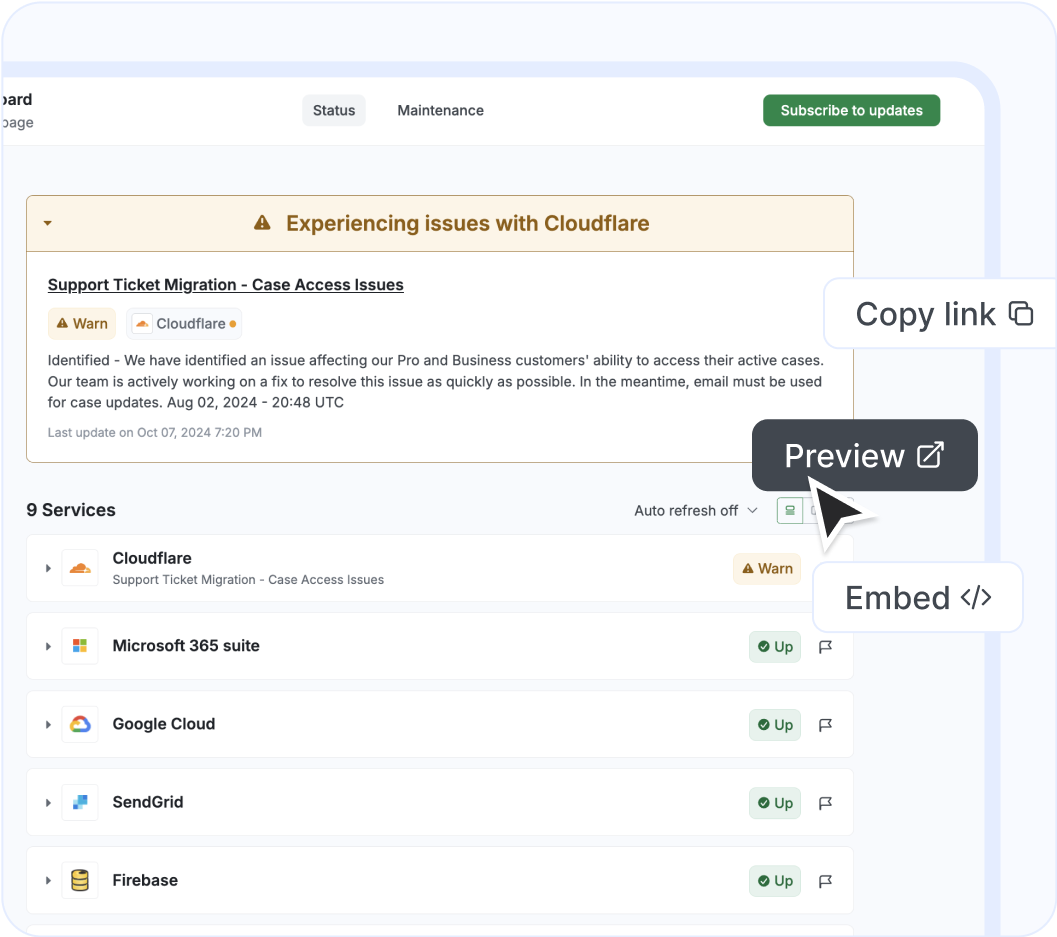
Monitor outages, incidents, and service disruptions across all your SaaS providers from one centralized view.
Modern businesses depend on dozens, sometimes hundreds, of cloud services. When one fails, teams waste valuable time checking scattered status pages, searching social media, and trying to determine whether the issue is internal or provider-related.
Status aggregation solves this problem by centralizing status information across your entire SaaS stack into a single operational view.
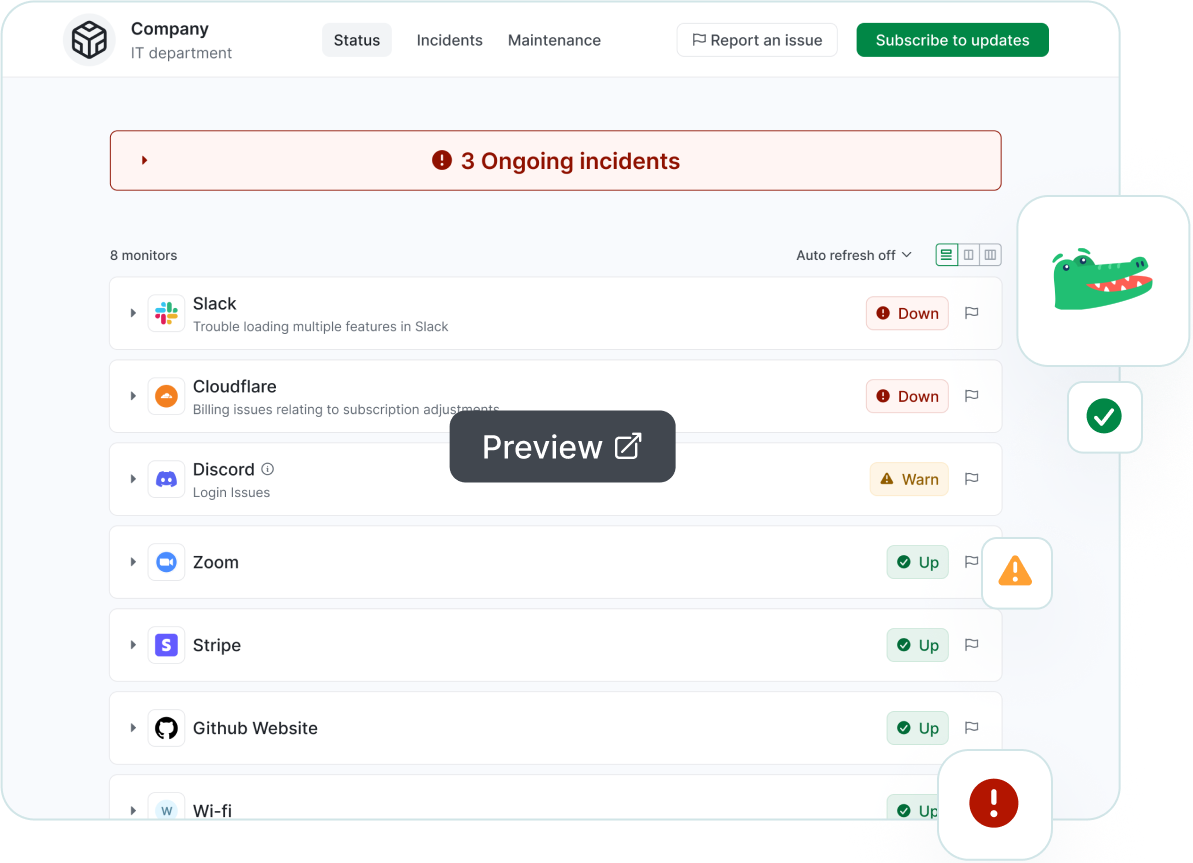
Status aggregation is the process of collecting, normalizing, and monitoring service health information from multiple providers in one centralized platform.
Instead of visiting individual status pages for:
…teams use a status aggregation platform to monitor all providers from a single dashboard.
A modern status aggregation system combines:
The result is faster awareness, fewer blind spots, and more proactive incident response.
Try for free
Most organizations rely heavily on SaaS vendors. But during outages, operational visibility becomes fragmented.
IT teams often find themselves:
"This creates operational delays exactly when fast communication matters most. The larger the SaaS footprint, the bigger the problem becomes."
Provider status pages are useful, but they have limitations. Common issues include:
Many providers wait until incidents are internally confirmed before publishing updates.
This creates a visibility gap between when users experience issues and when providers officially acknowledge them.
Different providers use different terminology, update frequencies, and incident structures.
Some publish detailed updates, while others provide minimal information.
Each provider has its own separate status page.
Teams must manually check each one during incidents.
Many status pages only support broad notifications.
Teams receive alerts for services or regions they do not even use.
On February 19, 2026, Trello users worldwide began reporting issues loading boards and accessing workspaces.
Status aggregation systems monitoring real-time signals detected the issue before Trello officially acknowledged the incident.
14:24 UTC
First outage reports received.
14:28 UTC
Early Warning Signal statistically significant clustering of outage reports.
14:30–14:55 UTC
Global reports rapidly increased across multiple regions.
15:08 UTC
Trello officially acknowledged the incident publicly.
This created a 39-minute visibility advantage for teams monitoring aggregated outage intelligence. Learn more here.
Those 39 minutes can significantly reduce operational impact. Early awareness allows organizations to:
In many organizations, the difference between reactive and proactive incident response is simply awareness timing.
Schedule a demoModern platforms collect data from multiple sources simultaneously.
Platforms ingest updates directly from vendor status pages and APIs.
Automated monitoring systems identify abnormal outage patterns.
Real-time outage reports are analyzed geographically and statistically.
Different provider formats are standardized into a unified monitoring experience.
Notifications can be filtered by: provider, product, component, region, and severity. This reduces noise and improves operational relevance.
Transform how your IT and support teams handle third-party service disruptions.
Monitor all cloud dependencies from one dashboard instead of dozens of separate status pages.
Detect incidents before providers officially acknowledge them.
Filter notifications to only the services and components your organization actually uses.
Provide customer-facing teams with faster, more accurate outage communication.
Track historical reliability and acknowledgment delays across providers.
Reduce time spent manually checking status pages during incidents.
Traditional infrastructure monitoring focuses on:
But modern businesses also depend heavily on external SaaS vendors.
Infrastructure monitoring alone cannot detect:
Status aggregation complements infrastructure monitoring by providing visibility into external dependencies.
Monitor all SaaS dependencies from a centralized operational dashboard.
Reduce ticket volume by identifying provider outages quickly.
Accelerate triage during service disruptions.
Monitor customer-facing SaaS ecosystems efficiently.
Track reliability across hundreds of cloud vendors.
Not all status aggregation solutions are equal. Key capabilities include:
As organizations increase SaaS adoption, external dependency monitoring becomes increasingly critical.
The average enterprise now relies on dozens or hundreds of cloud services for:
When even one provider fails, operational disruption can spread rapidly.
Status aggregation helps organizations move from reactive troubleshooting to proactive operational awareness.
Modern IT operations require visibility beyond internal infrastructure.
Status aggregation provides a centralized way to monitor outages, incidents, and reliability across all the cloud services your organization depends on.
Instead of checking dozens of vendor status pages manually, monitor your SaaS ecosystem from one operational view.
Try for free